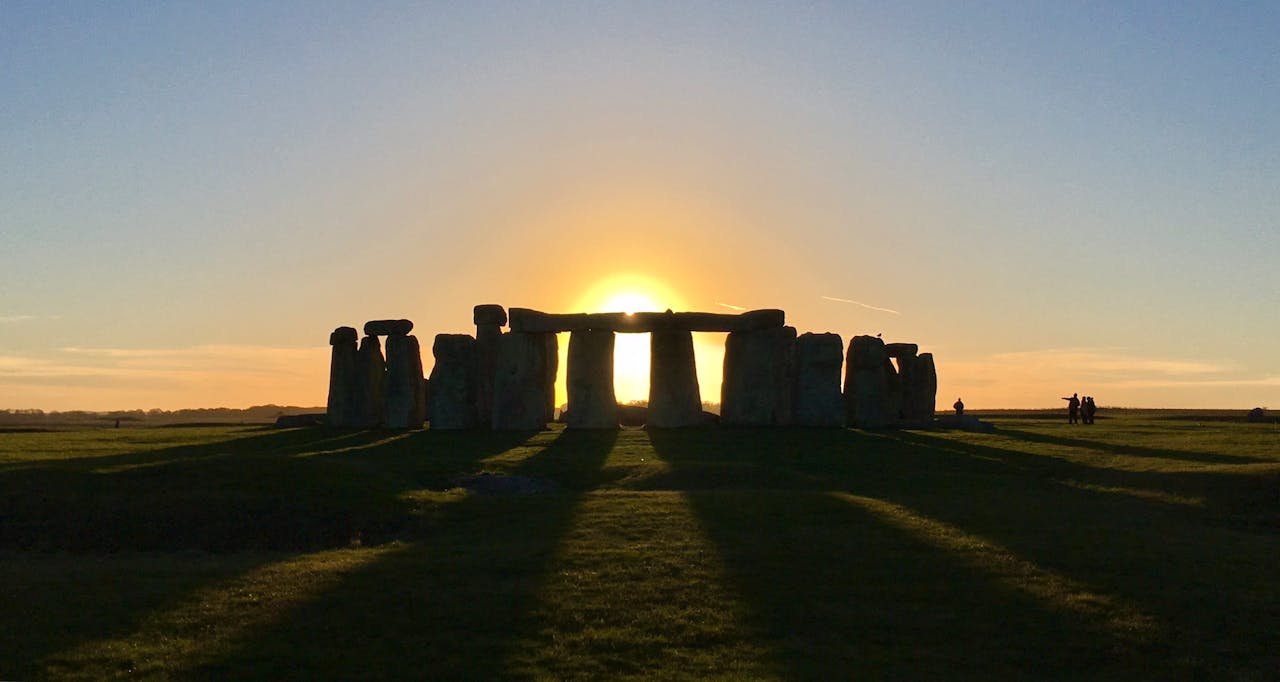
Stonehenge, the solstice, and a monument built for the sky
Stonehenge on Salisbury Plain in Wiltshire, England, is one of the world’s most famous places to explore Stonehenge and the solstice. It is not only a prehistoric stone circle, but also a carefully positioned monument that connects architecture, landscape, and the movement of the sun. At key moments of the year, especially the summer and winter solstice, the monument frames the horizon in a way that feels intentional, memorable, and deeply symbolic.
Quick takeaway: Stonehenge’s main axis lines up in a meaningful way with the summer solstice sunrise and the winter solstice sunset. This link to the sky is a major part of how the monument works, alongside its wider landscape and seasonal gatherings.
What the solstice is, and why it mattered
The solstices are the two points in the year when the sun reaches its most extreme rising and setting positions on the horizon. Around June, daylight lasts the longest. Around December, it is the shortest. For farming and herding communities, these were not abstract calendar dates. They were powerful signals for seasonal change: light, temperature, food planning, movement, and communal events. A monument that makes these turning points visible and shared can help a society “lock in” the rhythm of the year.
How Stonehenge relates to the solstice
The most discussed connection between Stonehenge and the solstice is the alignment of the site’s central axis. Looking along this axis, the sun at the summer solstice appears in a very specific direction on the horizon, while the winter solstice points the opposite way. Stonehenge is also part of a much larger ceremonial landscape, with routes, burial mounds, and other prehistoric features. The alignment makes the monument feel less isolated and more like a designed “node” inside a meaningful terrain.
A feature often mentioned in solstice discussions is the Heel Stone, placed along the monument’s axis. Under the right conditions, the position of the sun relative to the stones can create a strong visual moment, with light appearing to line up through gaps and uprights. Even though some stones have fallen or been re-erected over time, the overall idea remains clear: this is architecture that encourages people to look, to notice, and to remember.
An observatory, or something different?
It is tempting to describe Stonehenge as a prehistoric observatory. A more useful way to think about it is as a memory of light: a place where the solar cycle becomes a shared experience. The goal may not have been daily precision, but rather fixing key seasonal moments in people’s minds through ritual, storytelling, and gathering. The monument’s scale suggests it carried social weight too, bringing communities together around shared time and shared meaning.
A simple way to read the site: imagine Stonehenge as a stage where the sun “performs” on two special days. The stones do not move, but the light does, and that contrast can turn astronomy into ceremony.
Why the open landscape matters
Stonehenge works visually because of its setting. Salisbury Plain offers wide skies and a relatively open horizon, which makes the sun’s rising and setting positions easier to observe. In many ancient cultures, the horizon was a boundary full of meaning: the place where celestial bodies “arrive” and “depart.” Building a monument that speaks directly to that line is a way of shaping a cosmic idea into something people can see and return to.
The stones also create a changing geometry of light and shadow. Uprights, lintels, gaps, and long shadows shift through the day and across the seasons. In that sense, the sky is not background scenery. It is part of the monument’s design.
Summer solstice and winter solstice: two different messages
Modern attention often focuses on the summer solstice sunrise, because it is dramatic and easy to imagine in photographs. But the winter solstice may have carried an even deeper emotional meaning for prehistoric communities. It is the turning point of darkness, the moment when light begins to return. If Stonehenge helped mark that shift, then it was not only about timekeeping. It was also about reassurance, renewal, and continuity.
Why people still gather at the solstice today
Most of us no longer depend on seasonal light in the same direct way, yet the solstice still feels powerful. Seeing the sun reach its extremes reminds us that time is cyclical, not just a straight line of dates. Stonehenge amplifies that feeling because it gives the cycle a stable, ancient, communal form, and it does so in a landscape that still feels open to the sky.
For deeper reading, these official and museum resources give reliable context on the site, its protection, and the solstice itself.
External links (relevant and authoritative)
English Heritage: Stonehenge (official site information)
UNESCO: Stonehenge, Avebury and Associated Sites (World Heritage listing)
Royal Museums Greenwich: solstice guide (astronomy context)
Note: solstice access, times, and visitor rules can change from year to year. Check the official English Heritage guidance before planning a visit.