This page mentions Cambodia or Thailand. Some areas can be affected by border closures, localised fighting, or sudden restrictions. Check official travel advice for your nationality and confirm transport routes and insurance coverage before making plans. If your trip is not essential, consider waiting for a calmer period.
Volunteering with elephants can mean very different things. Some projects use the language of rescue, sanctuary or conservation while still selling close-contact experiences. Others keep visitors and volunteers at a respectful distance and focus their work on habitat protection, research, food preparation, maintenance, reforestation, education or human-elephant coexistence.
For anyone trying to choose responsibly, the most useful question is not simply “Is this an elephant sanctuary?” but “What are the elephants expected to do for visitors?”
Editorial note: This guide is based on publicly available information checked in September 2026. Policies, fees, availability and welfare practices can change, so always check the current information directly before applying or booking.
What ethical elephant volunteering should look like
There is no single worldwide label that automatically proves that an elephant project is ethical. Words such as “sanctuary”, “rescue” and “retirement home” can be used by very different types of organisations.
As a practical starting point, World Animal Protection recommends choosing elephant venues where people can observe rather than touch the animals. Its 2026 guidance advises against riding, bathing and other forced interactions, and places particular importance on space, social behaviour, foraging and elephant autonomy. ABTA likewise classifies elephant riding, bathing, shows and tourist contact or feeding without a barrier as unacceptable practices.
For sanctuaries and rescue centres, another useful reference is the Global Federation of Animal Sanctuaries. GFAS accreditation is not the only possible indicator of responsible work, but its standards provide a useful benchmark. Among other requirements, eligible wildlife sanctuaries should not breed animals for commercial purposes, should not trade animals, and should not allow direct public contact with wildlife.
A stronger elephant volunteer program will usually show several of the following characteristics:
- no elephant riding, performances, tricks or staged photo opportunities;
- no routine bathing, hugging or touching by tourists or volunteers;
- observation from a respectful distance, with elephants able to move away;
- opportunities for elephants to forage, socialise, roam and express natural behaviour;
- no breeding designed to produce baby elephants for tourism;
- qualified keepers and veterinary professionals responsible for necessary animal handling;
- clear information about where the elephants came from and why they are in human care;
- volunteer tasks that support welfare or conservation rather than create entertainment;
- meaningful employment and participation for local staff and communities;
- transparent information about fees, accommodation, safety and how the program is funded.
Voluntouring.org also has a broader guide on how to recognise a real animal sanctuary and avoid misleading wildlife attractions.
Why hands-off volunteering can be more meaningful
People often imagine that volunteering with elephants should involve feeding, washing or physically caring for the animals. In reality, responsible volunteering may involve very little direct elephant contact.
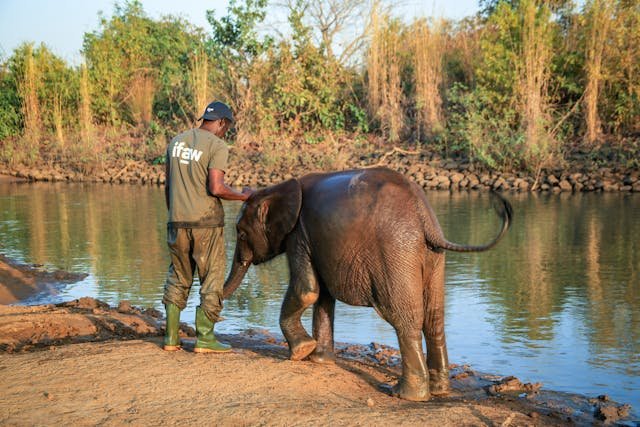
A volunteer can contribute by preparing food away from the animals, maintaining facilities, planting browse and native vegetation, restoring habitat, collecting behavioural data, supporting community education, monitoring wild elephant movements or helping protect water infrastructure from conflict. These tasks may be less dramatic than an elephant selfie, but they can be much closer to the actual needs of a conservation project.
Necessary contact by trained mahouts, keepers or veterinary teams is a different issue from contact created for visitors. In rescue and rehabilitation settings, professionals may need to perform health checks, medical procedures or carefully managed training for safe husbandry. That does not mean the same contact should be offered as a tourist or volunteer activity.
Elephant volunteer and conservation programs to research
The examples below use different models. Some care for elephants that cannot return to the wild, while others work with free-roaming populations and local communities. They should not be treated as interchangeable experiences.
Phuket Elephant Sanctuary, Thailand
Phuket Elephant Sanctuary offers volunteer opportunities for adults who are physically able to work in Phuket’s hot and humid conditions. Tasks can include food preparation, cleaning facilities, maintenance and other practical support.
In April 2026 the sanctuary discontinued visitor feeding interactions and moved to a fully hands-off, observation-only model. World Animal Protection’s 2026 Elephant-Friendly Tourist Guide lists Phuket Elephant Sanctuary among its elephant-friendly venues.
Why it is worth researching: the current model separates volunteer work from direct tourist interaction and the move to observation-only is clearly documented. Check current volunteer dates before arranging travel because the program is not available throughout the entire year.
Following Giants, Koh Lanta, Thailand
Following Giants runs an observation-only volunteer week on Koh Lanta for participants aged 18 and over. Current activities include assisting guides, reforestation work, planting, preparing vitamin or herbal balls, cleaning and observing elephant behaviour.
World Animal Protection lists both Following Giants Koh Lanta and its Krabi venue among the elephant-friendly venues in its 2026 guide.
Why it is worth researching: the program combines sanctuary support with habitat work while keeping the visitor experience observation-led.
Mahouts Elephant Foundation LIFE project, Thailand
The Mahouts Elephant Foundation LIFE project offers a six-day volunteering experience with a strong community focus. Participants can assist with community projects and hike into the forest to observe elephants living and roaming there from a respectful distance.
World Animal Protection includes the LIFE project among the elephant-friendly venues in its 2026 guide.
Why it is worth researching: it places elephant habitat and Karen community participation at the centre of the experience rather than offering close-contact activities.
Elephant Valley Project, Cambodia
Elephant Valley Project in Mondulkiri combines elephant observation with practical volunteering. Its current public policy is straightforward: no rides, no tricks, no feeding and no swimming with elephants.
Volunteer work may include planting supplementary elephant food, reforestation, trail maintenance, construction and other site projects. The organisation states that volunteers do not work directly with the elephants because the animals live in a natural forest environment. World Animal Protection lists Elephant Valley Project as elephant-friendly in its 2026 guide.
Why it is worth researching: volunteers contribute to the infrastructure, forest and welfare work around the elephants rather than using the animals as the activity.
Wildlife SOS, India
Wildlife SOS offers a five-day volunteer program connected with its rescue facilities near Agra and Mathura. Activities can include food preparation, enrichment, cleaning and maintenance, gardening and routine observation of rescued animals.
The organisation explicitly states that direct physical contact with elephants is not part of the volunteer program and that elephant interaction is limited to trained keepers.
Why it is worth researching: it is a rescue and care program rather than a wild-elephant field project, but its current volunteer policy draws a clear boundary around direct contact.
Elephant Conservation Center, Laos
The Elephant Conservation Center in Sayaboury currently offers a seven-day conservation volunteering program combining field observation, habitat restoration, behavioural data collection, veterinary and welfare learning, and work connected with elephant rewilding.
The program describes participant interactions as observation-only and supervised by ECC professionals. Because the centre combines sanctuary care, research and rewilding work, prospective volunteers should read the current itinerary carefully and distinguish activities performed by professional staff from those open to participants.
Why it is worth researching: it provides a more science-oriented format than many short wildlife tourism programs and includes data collection and habitat work.
SLWCS volunteer program in Wasgamuwa, Sri Lanka
The Sri Lanka Wildlife Conservation Society offers a field-based program near Wasgamuwa National Park. Rather than caring for captive elephants, volunteers contribute to research and coexistence work involving wild Asian elephants.
Activities can include gathering wildlife and environmental data, documenting human-elephant conflict, discussing practical solutions with local communities and supporting environmental education.
Why it is worth researching: the purpose is understanding and reducing conflict between people and free-ranging elephants, not providing elephant encounters.
Elephant-Human Relations Aid, Namibia
Elephant-Human Relations Aid, or EHRA, works with Namibia’s free-roaming desert elephants and rural communities. Its adult volunteer program currently starts at two weeks.
One part of the program focuses on building protective walls around water pumps, tanks and other infrastructure so elephants can access water without damaging essential equipment. Another part involves tracking and monitoring elephants, recording locations and identification information, and helping assess potential human-elephant conflict.
Why it is worth researching: it is a clear example of conservation volunteering where the central challenge is coexistence between wild elephants and local communities.
Save the Elephants internships, Kenya
Save the Elephants offers research internships in Kenya, including placements at its Tsavo Coexistence and Research Centre. These are not casual voluntourism placements. The Tsavo program is designed for graduates pursuing conservation careers and currently runs for approximately four to ten weeks.
Eligibility and available internship tracks can change by intake, so candidates should use the organisation’s current careers pages rather than relying on old third-party listings.
Why it is worth researching: it suits people looking for a more serious research and conservation pathway rather than a short elephant experience.
The Elephant Sanctuary in Tennessee, United States
The Elephant Sanctuary in Tennessee is useful as an example of what sanctuary volunteering can look like when elephant welfare takes priority over visitor access. On-site volunteers work on practical projects such as maintenance, vegetation management and enrichment preparation. Volunteers do not interact with elephants, and seeing an elephant is not guaranteed.
The Sanctuary was re-accredited by GFAS in 2025. Applications for its limited 2026 Volunteer Days are already closed, so this is not a currently open placement. Interested readers can monitor the official site for future rounds.
Why it is worth researching: it illustrates an important principle: an ethical volunteer opportunity does not need to promise access to the animals at all.
How to compare programs before paying
A polished website and good reviews are not enough. Before paying a program fee, send specific questions and look for precise answers.
- Can volunteers touch, bathe, ride or hand-feed elephants?
- Are elephant shows, performances, painting or staged photo opportunities offered anywhere at the facility?
- Can an elephant choose to leave the viewing area or end an interaction?
- Who is allowed to handle elephants, and what training do those people have?
- Does the organisation breed elephants? If so, why?
- How were the elephants acquired?
- What proportion of the volunteer schedule is conservation work, research, maintenance or education?
- Are volunteers filling roles that should reasonably be paid local jobs?
- How are local mahouts, researchers, educators and communities involved?
- What does the program fee include and how does it support the project?
- What safety procedures, insurance requirements and emergency plans apply?
- Is there an independent accreditation, welfare assessment or published policy that can be checked?
A responsible organisation should be comfortable explaining its practices. If answers are vague, defensive or centred mainly on how close you can get to the elephants, keep researching.
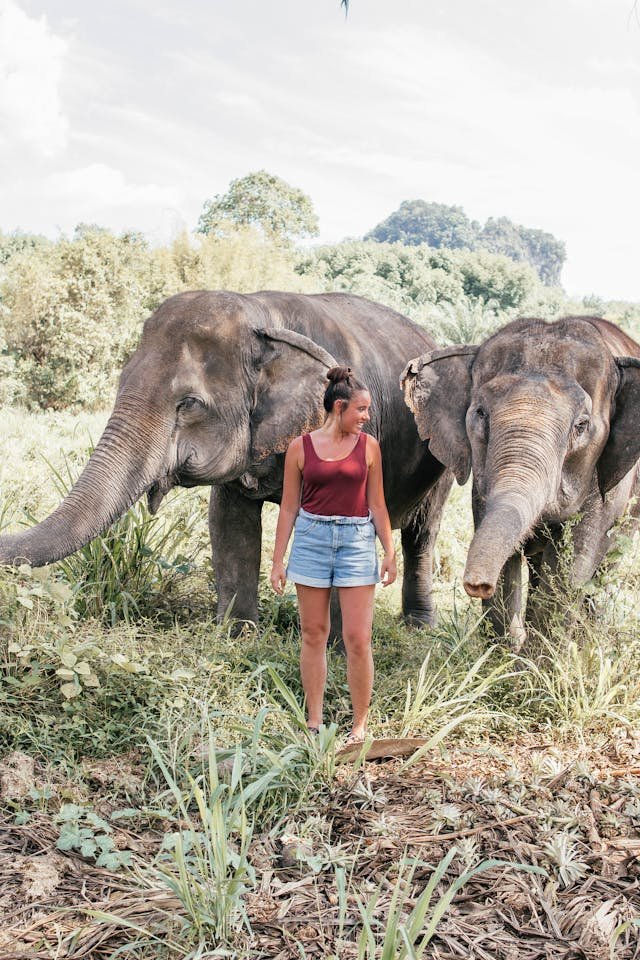
Red flags to take seriously
- Riding: elephant rides are incompatible with the welfare approach used in the guidance cited above.
- Bathing as a scheduled tourist activity: washing elephants may be marketed as a gentler alternative to riding, but it is still a form of close-contact tourism.
- Guaranteed touching or selfies: regular physical access usually means the animal has been trained or managed to tolerate repeated human interaction.
- Shows and tricks: painting, football, headstands and similar performances exist for the audience, not for the elephant.
- Baby elephants used as an attraction: ask where young elephants came from and whether breeding is taking place.
- The word “sanctuary” presented as proof: the name itself says very little about welfare standards.
- Unclear finances: a volunteer fee is not automatically a problem, but the organisation should clearly explain what participants are paying for.
- Conservation claims without conservation work: if most of the schedule consists of animal interaction and photography, the label deserves scrutiny.
Is elephant volunteering ethical?
Can volunteering with elephants be ethical?
Yes, but the ethical value depends on the model. Field research, habitat restoration, coexistence projects, sanctuary maintenance and observation-only programs can support elephant welfare or conservation without turning physical interaction into a product.
Should volunteers touch elephants?
For ordinary volunteers and visitors, a hands-off approach is the safer default. Necessary contact by qualified veterinary or animal-care professionals is different from contact offered as part of the visitor experience.
Is bathing elephants ethical?
Major animal-welfare guidance increasingly advises against tourist elephant bathing. ABTA classifies elephant bathing as an unacceptable tourism practice, while World Animal Protection recommends observation rather than touching.
Are all elephant sanctuaries ethical?
No. “Sanctuary” is not a universal certification. Check the organisation’s breeding policy, visitor contact, animal acquisition, daily management, professional care, transparency and any credible external assessment.
Is it better to volunteer with wild elephants?
Not automatically, but wild-elephant conservation avoids many of the welfare issues created by captive entertainment. Projects focused on research, habitat protection and human-elephant coexistence can be particularly valuable when they are led by qualified organisations and local communities.
Why do many elephant volunteer programs charge fees?
Field accommodation, staff, transport, food, equipment and long-term animal care all cost money. A fee is therefore not a red flag by itself. What matters is transparency, realistic claims and whether the volunteer program genuinely supports the organisation’s work rather than simply selling access to elephants.
Before you apply
Check the project’s current minimum age, physical requirements, dates, fees and cancellation terms directly with the organisation. Also verify visa rules, travel insurance, vaccinations or health advice, local laws and any special requirements for volunteering or research in the destination.
Voluntouring.org promotes volunteering and work-exchange opportunities for adults aged 18 and over. External organisations may publish different age rules, but readers using this guide should treat it as an adult volunteering resource.
One final rule: if a program’s main selling point is touching an elephant, the elephant is probably part of the product. Look instead for projects where the work, habitat, research, welfare and local community remain important even when physical interaction is removed.