What would six months of climate action look like when the work begins with local communities rather than a classroom?
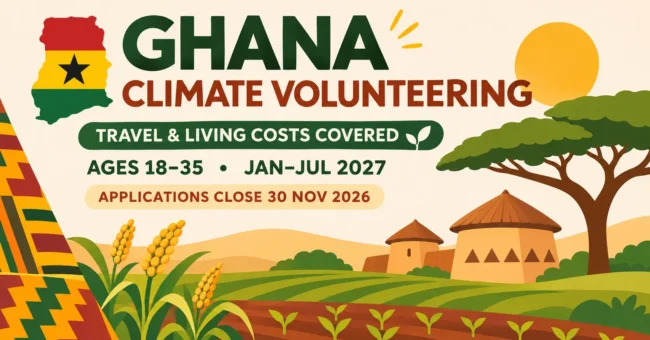
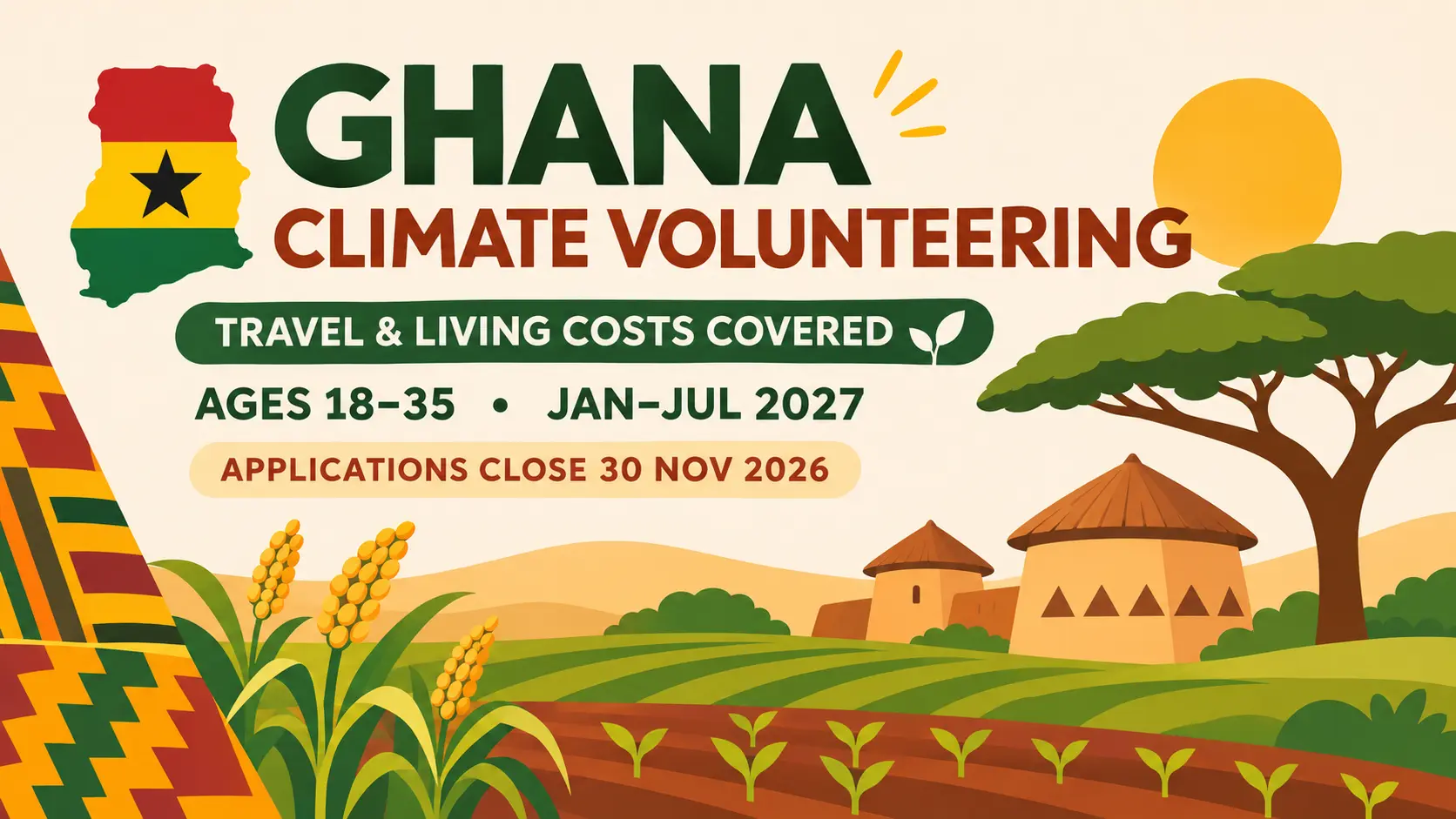
An EU-supported volunteering opportunity in Tamale, northern Ghana, is inviting applications for a climate adaptation placement running from 4 January to 3 July 2027. The role involves sustainable agriculture, community resilience and practical environmental initiatives. Travel, accommodation, food, insurance and an allowance for personal expenses are covered under the European Solidarity Corps Humanitarian Aid programme. The application deadline is 30 November 2026.
This is not a paid job or a short volunteer holiday. The position, listed as Climate Change Adaptation volunteer on the European Youth Portal, involves a substantial commitment with NGO Mondo and the Ghana Developing Communities Association (GDCA). Importantly, candidates must be 18 to 35 years old, meet the residence and participation requirements, and have completed the compulsory Humanitarian Aid Volunteering training before applying.
Climate volunteering in Ghana at a glance 🕵🏻♀️
Location: Tamale, northern Ghana. Dates: 4 January to 3 July 2027. Age: 18–35. Programme: European Solidarity Corps Humanitarian Aid Volunteering. Participation fee: none. Mandatory training: must be completed before applying. Deadline: 30 November 2026 at 23:59, as shown on the European Youth Portal.
Why climate adaptation matters in northern Ghana
Many rural communities in northern Ghana depend on agriculture that relies heavily on seasonal rainfall. Changing rainfall patterns, heat, dry spells and flooding can make farming less predictable, affecting food security, household income and everyday decisions about water and land.
The opportunity focuses on adaptation: helping communities identify practical ways to respond to changing environmental conditions, strengthen local capacities and develop more resilient livelihoods. It is a community development role connected to climate action, rather than a placement centred on wildlife tourism or planting trees for a few days.
What the volunteer will actually do
According to the official listing, the selected volunteer will support GDCA and its partners with work that may include:
- Assessing climate-related vulnerabilities and identifying possible local responses.
- Supporting sustainable agriculture, including practices using organic inputs.
- Helping with energy-saving, waste reduction, repair, reuse and recycling activities.
- Contributing to food management and income-diversification initiatives.
- Facilitating discussions, training and engagement with local stakeholders.
The listing also refers to the BRIDGE project, which connects community resilience with skills development and gender equality. Activities may involve training, digital literacy and initiatives that particularly support women. The role calls for collaboration with existing local organisations and community members, not for an international volunteer to arrive with ready-made solutions.
Under the ESCESC, the European Solidarity Corps, is an EU programme supporting young people in volunteering and solidarity projects, with programme-specific funding, support and participation conditions. Humanitarian Aid framework, individual placements are full-time, normally involving between 30 and 38 hours per week. Applicants should be prepared for ongoing project responsibilities, fieldwork or meetings as arranged by the host.
Who is eligible to apply?
This opportunity is aimed at people who can make a practical contribution to community-based climate action. The official participant profile values adaptability, cultural sensitivity, communication and facilitation skills, along with knowledge of climate change, agriculture, environmental management or related subjects. Previous experience in community livelihoods, training or project work is an advantage; the listing does not identify a particular university degree as a universal requirement.
Humanitarian Aid Volunteering has specific eligibility rules:
- Age: 18 to 35 at the start of the activity.
- Residence: legal residence in an EU Member State or an eligible programme-associated country, including Iceland, Liechtenstein, North Macedonia and Türkiye.
- Registration: a European Solidarity Corps profile showing interest in Humanitarian Aid Volunteering.
- Training: successful completion of the compulsory Humanitarian Aid training pathway.
- Previous participation: applicants must meet the programme’s limits on earlier EU and individual humanitarian volunteering.
The project’s own country and territory list includes Italy and many other European locations. Applicants should check both that list and the general programme requirements on the official portal. Eligibility depends on legal residence and programme rules, not simply on holding a passport from a listed country.
English: the project listing does not state a formal language level. Since the work involves communication, training and collaboration, candidates should ask Mondo what language skills are expected in practice.
The mandatory training is especially important
This is the detail to check before spending time on an application. The role belongs to the ESC Humanitarian Aid Volunteering strand, which has different requirements from ordinary ESC volunteering. Registering on the Youth Portal or completing only general ESC online training is not sufficient.
The humanitarian pathway involves a self-assessment, online learning and an online test, followed by a face-to-face training component. Candidates must successfully complete the required training before they are ready to apply for humanitarian placements.
With applications closing on 30 November 2026, this particular call is likely to be most realistic for people who have already completed that training. Anyone starting the process now should verify whether they could become eligible in time; training places and schedules are not guaranteed.
What is funded, and what should applicants clarify?
There is no participation fee. The European Solidarity Corps explicitly states that volunteers cannot be required to pay a fee for taking part in an activity.
For Humanitarian Aid placements, the EU programme provides for:
- Travel: the basic cost of travel to and from the placement.
- Accommodation and food: essential living costs during the activity.
- Insurance: complementary insurance coverage and relevant support services.
- Personal allowance: a modest amount for personal expenses, rather than a salary.
For this particular role, GDCA states that accommodation will be near its office and have water, electricity, internet and kitchen facilities. Volunteers can prepare meals or use nearby food vendors; transport for official project duties is provided by GDCA.
The exact personal allowance, flight reimbursement arrangements and any spending limits are not specified in the public opportunity description. Before accepting a placement, applicants should ask whether they need to buy flights in advance, how reimbursements work, how the food budget is handled, and which expenses will remain their own responsibility. No specific allowance amount should be assumed.
Living and volunteering in Tamale
The placement is based in Tamale, Ghana, an important urban centre in the north of the country. The official page gives the dates as 4 January to 3 July 2027 and labels the activity as 24 weeks. Because those dates cover nearly six calendar months, candidates should confirm the precise attendance and travel dates with the organisers.
Volunteers should expect to work within the host organisation’s existing programme and adapt to its schedules, local partnerships and community priorities. This is a long-term professional and cultural commitment, not a self-guided travel itinerary.
Visas, travel arrangements and safety
Entry and volunteering documentation depend on the applicant’s nationality and circumstances. Before departure, candidates should confirm the relevant Ghanaian visa or permission requirements, the documents supplied by the participating organisations, any eligible visa-related support and the insurance terms.
Travel in northern Ghana also requires careful planning. Government travel advice identifies security concerns in some northern areas and on particular roads. For example, the UK’s Foreign, Commonwealth & Development Office advises against all but essential travel to Bawku Municipality in the Upper East Region, while Italian consular information highlights incidents affecting some routes north of Tamale. These warnings should not be confused with a blanket prohibition on visiting Tamale, but they are relevant to possible project travel.
Applicants should ask the host which communities and roads they will visit, how transport is organised, what emergency procedures are in place and whether the planned activities are compatible with current consular advice. Check official travel guidance again before making arrangements.
Six months of practical climate work, not a volunteer holiday
What makes this opportunity interesting is the chance to contribute to locally led work on climate resilience, farming and livelihoods over an extended period, with basic participation costs supported by a recognised EU programme. But the selection requirements are real, the work is full-time and the mandatory humanitarian training makes this call inaccessible to some otherwise motivated candidates.
For people who already meet the eligibility and training requirements, the placement offers an opportunity to bring useful skills to a community-focused project while learning from Ghanaian partners and their experience of environmental change.
Contact details 📧🔍
How to apply: Use the official European Youth Portal listing for Climate Change Adaptation volunteer. You will need to sign in or register with the European Solidarity Corps to check your eligibility and access the application process.
- Organisations: NGO Mondo (Estonia) and Ghana Developing Communities Association (Ghana).
- Location: Tamale, Ghana.
- Dates: 4 January to 3 July 2027.
- Age: 18–35, subject to the programme’s residence and previous-participation rules.
- Mandatory training: ESC Humanitarian Aid training, including its face-to-face component.
- Participation fee: none.
- Application deadline: 30 November 2026, 23:59 as displayed on the portal.
Mondo also provides information about its ESC volunteering process and publishes a contact address for questions: solidarity@mondo.org.ee. Contacting Mondo does not replace an application through the European Youth Portal.
Before applying: Check your training status, the list of eligible places of residence and the current listing. Ask the organisers about working language, the exact allowance, travel reimbursements, visas and the security arrangements for field activities.
Sources and further reading
- European Youth Portal: Climate Change Adaptation volunteer, official project listing.
- European Solidarity Corps: Humanitarian Aid Volunteering eligibility and funding.
- European Youth Portal: mandatory Humanitarian Aid training.
- European Solidarity Corps: participation principles and no-fee rule.
- NGO Mondo: ESC volunteering and application guidance.
- UK government: travel advice for regions of Ghana.
- Italian Ministry of Foreign Affairs: Ghana country information and travel advice (PDF).
Editorial review: 19 November 2026. This is an independent informational article based on a public European Solidarity Corps opportunity. It is not a recruitment request sent to Voluntouring.org or an endorsement of the placement.