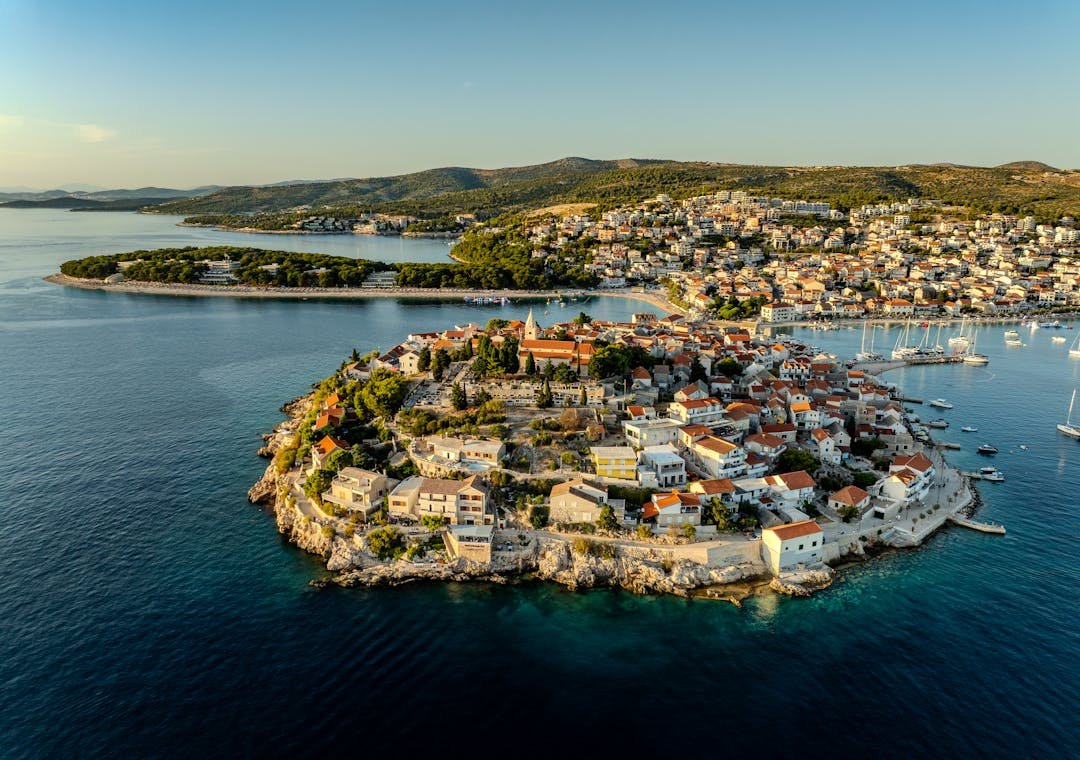
photo credit: Vladimir Srajber | This photo shows Primošten on Croatia’s Adriatic coast, a compact old town built on a rocky peninsula, surrounded by calm blue water. From above, you can clearly see the tight cluster of stone houses with terracotta roofs, the small harbour with boats, and the hilltop church that anchors the skyline. It is one of those places where the geography explains the history in a single glance.
Primošten at a glance
Primošten sits in Šibenik-Knin County, in northern Dalmatia, roughly between the coastal cities of Šibenik and Trogir. The older core of the town was once an islet close to the mainland. During periods of insecurity on the coast, especially in the 16th century, settlements like this relied on defensive walls and controlled access. Primošten’s very name is commonly linked to the Croatian verb primostiti, connected with the idea of “bridging” or “joining by a bridge”, a reference to the historic connection between the islet and the shore.
In practical terms, that “bridged” shape is exactly what makes Primošten so photogenic. Water wraps around the old centre on almost every side, so sunset light reflects back onto the stone and roof tiles. Even in busy summer months, a short walk uphill brings you into quieter lanes where you can feel the original scale of a small fishing and maritime community.
The hilltop church and the town’s classic silhouette
The landmark you notice first in this image is the Church of St. George (Sv. Juraj), positioned on the highest point of the old town. Sources commonly date the church’s origins to the late 15th century, with later rebuilding and extensions. From the churchyard, the view opens over the peninsula, the marina, and the bays beyond. It is a simple but powerful example of how Dalmatian coastal towns were planned: compact housing below, a sacred and visible high point above, and the sea always present as both livelihood and horizon.
If you visit, the best way to understand Primošten is to walk without a strict plan. The old streets are narrow on purpose, shaped by wind, heat, and the need to conserve space. You will also notice how many small viewpoints exist naturally, because the town rises quickly from the shoreline. That vertical feeling is part of what gives the place its “postcard” look from a drone perspective.
Stone lace vineyards and a landscape made by hand
Just outside town, Primošten is also known for its distinctive vineyards, especially the Bucavac Veliki area. The pattern is striking: small parcels of reddish soil are separated by dry-stone walls, creating a patchwork that locals often describe as “stone lace”. This is not just pretty geometry. It shows a long tradition of working difficult coastal terrain by hand, using stone to protect soil, reduce erosion, and define tiny cultivable plots.
The cultural importance of this landscape is widely recognised, including through its presence on UNESCO’s Tentative List as the “Primošten Vineyards”. Visiting these vineyards is a reminder that the most memorable Mediterranean scenery is often a collaboration between nature and repeated, patient human labour over generations.
How to experience Primošten in a slower way
This photo is taken in warm, low-angle light, the kind you get early or late in the day. That is also the best rhythm for visiting. Start with the peninsula when it is quiet, then step out towards the newer waterfront and harbour later. Primošten makes a great base for short day trips too: Šibenik’s historic centre is close by, and inland you can reach Krka National Park and its river landscapes within a reasonable drive.
If you enjoy coastal places with a strong local identity, try linking your visit to seasonal traditions rather than only beach time. Look for local wine and olive oil, learn the basics of dry-stone wall building as a cultural skill, and take the time to notice how the town changes when cruise traffic is absent and everyday life returns to the foreground.
Maps and useful links
Direct map link to Primošten: Primošten on Google Maps 📍
Pages to explore:
- Visit Primošten (official local tourism site),
- UNESCO Tentative List: Primošten Vineyards,
- Bucavac vineyard info.
Want to stay longer and connect with local life?
If this view makes you want to spend more time in Croatia, consider combining travel with a meaningful volunteer experience. Many projects focus on community life, nature and conservation, eco-farms, hospitality support, and cultural exchange. Always check the conditions carefully, ask clear questions about hours and responsibilities, and make sure your plans match local rules and visa requirements.