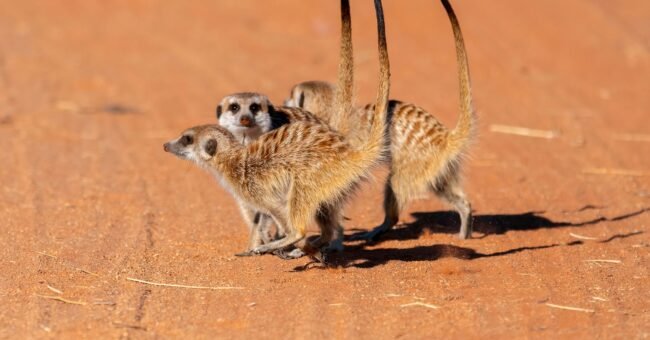
What would it be like to spend an entire year in the Kalahari Desert, following wild meerkats and helping scientists understand their extraordinary social lives?
The Kalahari Meerkat Project in South Africa is accepting applications from international volunteers interested in joining its long-running wildlife research programme. Based at the Kalahari Research Centre, the project offers the opportunity to spend 12 months observing wild meerkats, collecting scientific data and living in a remote part of the Northern Cape.
Food and private accommodation are provided free of charge, alongside a small monthly allowance. Previous field research experience is preferred but not compulsory.
Volunteer research in the Kalahari at a glance 🐾
- Country: South Africa 🇿🇦
- Location: Kuruman River Reserve, Northern Cape.
- Duration: 12 months.
- Participation fee: None.
- Accommodation: Free private room.
- Meals: Provided free of charge.
- Monthly allowance: Approximately €30.
- International applicants: Welcome.
- Application deadline: Rolling applications.
A year among wild meerkats
Established in 1993, the Kalahari Meerkat Project is one of the best-known long-term studies of meerkat behaviour. Researchers have followed generations of wild meerkats to understand cooperation, communication, reproduction and social relationships. The animals live freely in their natural environment. Many have become accustomed to the presence of researchers, allowing their behaviour to be observed at close range without keeping them in captivity.
Visualizza questo post su Instagram
The project has also contributed to the popular wildlife documentary series Meerkat Manor, which followed the lives and rivalries of real meerkat families. Behind those stories lies an extensive scientific effort. Volunteer research assistants play an important role in maintaining the long-term observations on which the project depends.
What will volunteers actually do?
Participants receive training before carrying out fieldwork and collecting information about the animals. Typical activities include:
- Following wild meerkat groups across their territories.
- Recording behaviour, interactions and daily activities.
- Monitoring individual meerkats and recording their weights.
- Using radio-tracking equipment to locate study groups.
- Entering and managing scientific data.
- Helping with occasional research and field station tasks.
The work can involve long days outdoors, walking several kilometres in hot, dry conditions while carrying field equipment.
This is a behavioural ecology research project, not a wildlife sanctuary or an animal rehabilitation programme. Volunteers develop field research skills rather than receiving training in conservation management or captive animal care.
Visualizza questo post su Instagram
What is included, and what does it cost?
There is no participation fee. The Kalahari Research Centre provides a private room, basic meals, limited internet access and transport within South Africa to and from the research station.
Volunteers also receive a small monthly allowance, described by the organisation as approximately 550 South African rand, or €30. This is intended for minor personal expenses and should not be considered a salary.
After a volunteer successfully completes a full year, the project contributes €300 towards the international return flight.
However, international flights, medical insurance, visas, vaccinations, holidays and other personal expenses remain the volunteer’s responsibility.
The organisation recommends budgeting approximately £2,000 to £3,000 for expenses associated with spending a year abroad, depending on individual circumstances. Applicants should calculate their own costs carefully before committing.
Visualizza questo post su Instagram
Living at the Kalahari Research Centre
Life at the field station is communal and relatively isolated. Volunteers have their own rooms, while bathrooms, kitchens and common areas are shared with other team members. The international research community includes field assistants, managers, students and scientists working on different projects. Volunteers normally work five days a week and can take approximately three weeks of holiday during their year at the centre.
Although this is a remarkable place to experience wildlife, participants should be comfortable with limited facilities, a remote location and the practical challenges of working outdoors.
Who can apply?
Applications are welcome from people of any nationality, including candidates without a university degree in biology or previous fieldwork experience. Nevertheless, the project is selective. Applicants should have:
- Availability for the full 12-month commitment.
- A valid driving licence and driving experience.
- A good command of English.
- Good physical fitness and the ability to work in demanding outdoor conditions.
- A genuine interest in animal behaviour and scientific research.
Successful candidates will also need to arrange the appropriate South African immigration permission and medical insurance covering fieldwork activities. The programme may be especially interesting for people considering future studies or careers in zoology, behavioural ecology or related research fields, although a scientific career is not a requirement for applying.
When can you apply?
The Kalahari Meerkat Project accepts applications on a rolling basis as positions become available.
There is no single published deadline for the current recruitment process. Applicants should contact the project to confirm available starting dates and whether places are being offered for their preferred period.
Contact details 📧🔍
The research volunteering programme is organised by the Kalahari Meerkat Project at the Kalahari Research Centre in South Africa.
- Project: Kalahari Meerkat Project.
- Location: Kuruman River Reserve, Northern Cape, South Africa.
- Duration: 12 months.
- Applications: Rolling, subject to availability.
- Email: meerkat.volunteers@gmail.com.
To apply, send a single PDF containing your CV and cover letter, named Surname_FirstName.pdf.
Your cover letter should explain your interest in the project, relevant experience, driving licence and driving experience, earliest possible starting date, and ability to stay for the full 12 months.
Before accepting a position, confirm all costs, insurance requirements and the appropriate visa or research permit.
Sources and further reading
- Kalahari Meerkat Project: Volunteer opportunities and conditions.
- Kalahari Meerkat Project: Volunteer FAQ, costs and requirements.
- Kalahari Meerkat Project: Official application instructions.
- Kalahari Research Centre: Scientific background and Meerkat Manor.
Information reviewed on 25 November 2026. This independent article is based on publicly available information. Applicants should confirm current availability and conditions directly with the organisers.