Global data offers a revealing perspective on the years we devote to sleeping, working, eating, caring, learning and leisure. But can numbers tell us what makes time meaningful?
A human life is made up largely of ordinary days. We sleep, eat, work, travel, care for ourselves and others, and find different ways to rest or enjoy our free time.
But what happens when all those daily hours are translated into years?
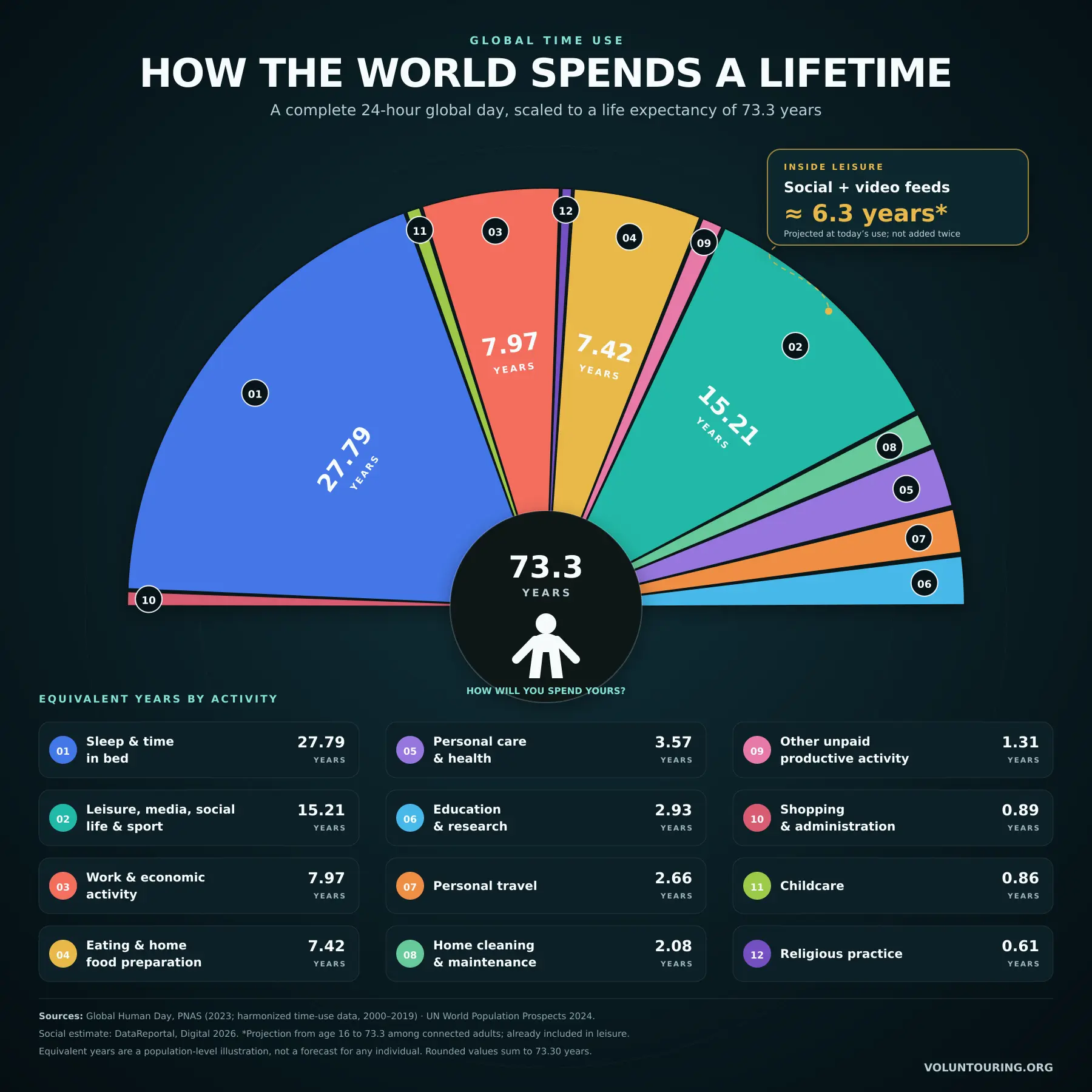
Our infographic combines global time-use estimates with an average life expectancy of 73.3 years. The result is not a prediction of how any individual person will live. It is a statistical portrait of how humanity, considered as a whole, distributes its time.
The activity data comes from The Global Human Day, a scientific study published in 2023 that brings together information from more than 140 countries. The researchers reconstructed a complete 24-hour global day using data collected between 2000 and 2019. We combined those proportions with the global life expectancy reported in the United Nations World Population Prospects 2024.
The chart therefore accounts for an entire 73.3-year lifetime, without adding an imaginary category for “time left”.
More than half of life is devoted to basic needs
The largest part of the chart is sleeping and time spent in bed: 27.79 years, or approximately 38% of a lifetime.
Eating and preparing food at home account for another 7.42 years, while personal care and health represent 3.57 years.
Together, these activities occupy 38.78 years. That is almost 53% of the average human lifetime.
This does not mean that these years are lost. Eating can be an occasion for connection and culture. Rest allows the body and mind to recover. Preparing food or caring for our health can be practical necessities, personal rituals or acts of care for other people.
The chart measures duration, not value.
Do we really spend only eight years working?
Economic activity represents 7.97 years, or approximately 11% of the global lifetime shown in the chart.
At first, this may seem surprisingly low. For many adults, work appears to dominate daily life for several decades.
However, this is an average for the whole human population. It includes children, students, retired people, people without formal employment and people of every age. It also distributes unpaid and domestic labour across several other categories.
Cleaning and maintaining the home account for 2.08 years. Other productive activities outside economic employment represent 1.31 years. Shopping and administrative tasks take another 0.89 years, while childcare accounts for 0.86 years.
The chart therefore reminds us that work is not limited to paid employment. Much of the effort required to sustain everyday life is divided among smaller and less visible categories.
Almost five hours of every global day are classified as leisure
Leisure, media, social activities and sport represent 15.21 years. This corresponds to almost five hours of the average global day.
It is a broad category. It may include meeting friends, watching television, reading, using digital media, exercising, playing, resting or participating in cultural and community activities.
Calling all of this “free time” can be misleading. Not everyone has the same freedom, resources or opportunities, and two hours spent doing different activities can produce very different experiences.
Rest is also not necessarily wasted time. A life in which every free moment must be productive would leave little room for play, curiosity, relationships or simply doing nothing.
Do we really spend 6.3 years on social media?
Our chart also includes a separate observation about social networks and video feeds.
Recent estimates suggest that connected adults spend around 18 hours and 36 minutes per week using social platforms and video feeds such as YouTube and TikTok. If a person maintained that rate from the age of 16 to 73.3, it would add up to approximately 6.3 years.
This number should be interpreted carefully.
It is a projection based on current behaviour among adult internet users, not a measurement covering the whole global population from birth. It also belongs within the larger leisure and media category, so it must not be added to the total a second time.
Still, it illustrates something important: small daily habits can become substantial parts of a lifetime when repeated for many years.
The more useful question may not be whether digital time is inherently good or bad, but whether the way we use it reflects what we actually want from it.
What the chart cannot tell us
A global average cannot describe an individual life.
It cannot show the enormous differences created by age, gender, income, geography, health, family responsibilities or access to employment and education. It also cannot fully represent activities that happen at the same time, such as caring for a child while cooking or travelling while using a phone.
Most importantly, the chart cannot measure meaning.
An hour devoted to another person may remain in our memory longer than a hundred routine hours. A difficult period can change the direction of a life. A journey lasting only a few weeks can influence how we see the world for years afterwards.
Time has quantity, but it also has texture, relationships and consequences.
Where does volunteering fit?
Volunteering is not automatically meaningful, and it is not the only way to live generously or contribute to a community. It should never be treated as proof that someone is living a better or more valuable life.
However, when an experience is organised fairly and approached with respect, volunteering can offer one possible way to use part of our time for participation, learning and human connection.
A few weeks may be almost invisible in a chart representing 73.3 years. Yet those weeks can contain new friendships, unfamiliar places, practical work, cultural exchange and experiences that continue to influence us long after we return home.
Not all our time is in our hands. Biology, work, circumstances and responsibilities shape much of it. But within those limits, many of us can still decide how to inhabit at least a small part of our lives.
If you would like to explore independent volunteering opportunities and cultural exchanges around the world, visit Voluntouring.org.
What would you like to make a little more time for?
Sources
- The Global Human Day, PNAS
- The Global Human Day dataset, Zenodo
- UN World Population Prospects 2024
- Digital 2026 social media data, DataReportal