



Sharing a home, managing land together or deciding how to divide everyday work can change the shape of a life. This list of ecovillages explores how communities around the world have developed different answers to these practical questions. Some began with a few people restoring rural buildings; others grew into neighbourhoods, networks or experimental towns.
Their priorities vary : ecological building and food growing may be central in one place, while another gives greater importance to shared income, political autonomy, artistic activity or spiritual practice. Some households keep separate finances and private homes. Others share much more of their work, resources and daily routines. This article brings together ecovillages, intentional communities and related projects from different parts of the world. It is a selection for readers curious about alternative ways of living, with short profiles that explain what makes each project distinctive.
How to use this page 🔍
This is a list of communities and related projects, not a directory of volunteering opportunities. Inclusion does not establish current availability for visits, accommodation, volunteering or new residents.
Open Europe, then choose a country to see its community profiles. You can also select any community’s name to collapse or reopen its description. The buttons lead to official websites or clearly identified profiles from the Global Ecovillage Network (GEN) and the Italian ecovillage network RIVE.
A few useful distinctions: an ecovillage brings ecological aims into community life; an intentional community is organised around a shared purpose or way of living; cohousing combines private homes with shared spaces and responsibilities. These categories can overlap.
Sources consulted: 28 October 2026.
Europe
Across Europe, ecological building, shared economies, spiritual exploration and urban self-management have produced very different community traditions. Open a country to explore its communities. Countries and community names are listed alphabetically.
Denmark
Christiania · Copenhagen, Denmark
An urban community shaped by resident self-management. Christiania emerged in former military grounds in 1971 and developed into a neighbourhood of homes, workshops and cultural spaces. Its history centres on residents taking responsibility for common affairs through community organisation and meetings. Questions of housing, autonomy and collective stewardship remain central to its identity. Christiania broadens this selection to include experiments in alternative living within a capital city.
Munksøgård · Roskilde, Denmark
Ecological cohousing with different forms of home ownership. Munksøgård is organised into neighbourhood groups with their own common houses. Rental, cooperative and privately owned homes accommodate different generations and household situations. Shared meals and activities connect the groups, while former farm buildings provide additional communal spaces. Its varied housing arrangements distinguish it from a commune with a single shared economy.
Svanholm · Zealand, Denmark
An intentional community built around income sharing and self-government. Near Skibby, Svanholm organises communal life around ecological commitments, economic sharing and collective responsibility. Its identity extends into the arrangements for work and everyday resources, making it relevant to readers interested in how a shared economy functions. The community also maintains connections with neighbours, schools and wider social organisations. Its alternative way of living develops through relationships both inside and beyond the settlement.
England (United Kingdom)
Braziers Park · Oxfordshire, England
A secular intentional community with an educational purpose. Braziers Park brings shared living, group learning and ecological land management together on a historic estate near Ipsden. Residents sustain the house and grounds, which include an organic kitchen garden, orchard and woodland. Social research and the practical challenges of cooperation remain central to its identity.
Old Hall Community · Suffolk, England
A rural community organised around shared domestic life and farming. At Old Hall in East Bergholt, families and individuals live in a historic building and work together on its surrounding land. Food growing, cooking, maintenance and other everyday tasks sustain the community. Private living areas sit alongside shared facilities, while residents maintain connections with the surrounding village.
Tinkers Bubble · Somerset, England
A woodland community built around living from the land. Near Little Norton, Tinkers Bubble combines forestry, orchards and food growing with self-built homes. Residents use horses, hand tools and a wood-fired steam sawmill, alongside solar electricity. The project explores how rural livelihoods and everyday needs can be organised with very limited reliance on fossil fuels and close attention to local resources.
France
La Borie Noble · Hérault, France
A rural community shaped by nonviolence and spiritual enquiry. At La Borie Noble, near Roqueredonde, the Regain collective combines shared daily life with farming, baking, woodworking and other crafts. Its connection with Lanza del Vasto’s Communauté de l’Arche places practical simplicity, cooperation and reflection at the centre of its approach to living together.
Le Hameau des Buis · Ardèche, France
An intergenerational ecovillage organised as a housing cooperative. Le Hameau des Buis combines homes built with timber, straw and earth with shared facilities, food growing and small productive activities. Its cooperative structure and shared governance connect ecological building with the social questions of living together across different ages and household arrangements.
Le Viel Audon · Ardèche, France
A collective hamlet rebuilt around cooperation and practical learning. Near Balazuc, beside the Ardèche River, Le Viel Audon brings together farming, rural restoration, environmental education and cultural activities. Its revival began in the 1970s, and its identity still connects the care of a living place with the sharing of skills between different generations.
Germany
Lebensgarten Steyerberg · Lower Saxony, Germany
An intentional community combining ecological living and individual responsibility. Lebensgarten connects mutual support, cultural activities and learning about communication and conflict. Residents remain financially responsible for themselves while participating in community decisions. Inspired partly by Findhorn, it accommodates different spiritual paths. An associated permaculture park connects practical land care with education.
Schloss Tempelhof · Baden-Württemberg, Germany
An intergenerational community with cooperative structures. Near Kreßberg, Schloss Tempelhof brings shared living, farming, education and local enterprises together in a village revived by its community. Existing buildings have been renovated alongside experimental construction, including an Earthship. Collective meals, consensus decisions and projects involving different generations connect ecological building with the organisation of everyday life.
Sieben Linden · Saxony-Anhalt, Germany
An ecovillage focused on the practical details of ecological living. Near Beetzendorf, Sieben Linden combines cooperative organisation with buildings made using materials such as straw, timber and clay. Food growing, shared facilities and attention to water, energy and consumption are part of its approach. The community also examines its environmental footprint and acknowledges the work still needed. Its example connects the design of a settlement with the habits of the people living there.

Photo: Michael Würfel,
004A mwuerfel,
via Wikimedia Commons,
CC BY-SA 3.0.
ZEGG · Bad Belzig, Germany
A residential community and education centre. ZEGG brings ecological site management together with an emphasis on communication, relationships and personal development. Community life provides the setting for exploring how trust and cooperation are built, including through its Forum practice. Shared resources, gardens and ecological infrastructure accompany this social work. Its identity therefore includes both the physical organisation of a place and the ways residents communicate and make decisions together.
Ireland
Cloughjordan Ecovillage · County Tipperary, Ireland
An ecological neighbourhood connected to an existing town. Cloughjordan brings homes designed for energy efficiency together with a district heating system, edible landscapes and native woodland. Its community project also addresses rural regeneration, local work and cultural life, linking environmental design with the everyday needs of a functioning neighbourhood.
Italy
Campanara · Tuscany, Italy
A rural ecological project with roots in the 1980s. Campanara lies near Palazzuolo sul Senio in the Tuscan-Romagnol Apennines. The project described by RIVE developed around a former church and rectory, linking the renewal of rural buildings with food growing, traditional crafts and artistic activities. Its aims include greater self-reliance and care for the surrounding ecosystem. Gardens, practical skills and the reuse of existing spaces are central to its account of ecological living.
Damanhur · Piedmont, Italy
A federation of spiritual communities. In the Canavese area north of Turin, Damanhur connects several communities through a shared philosophy, cultural activities and an evolving system of internal governance. Art is central to its identity, most visibly in the underground Temples of Humankind. Ecological projects and cooperative daily life sit alongside an explicitly spiritual worldview. Understanding that worldview is an important part of understanding the community.
Granara · Emilia-Romagna, Italy
An ecological village connecting community life, education and the arts. In the Parma Apennines, near Valmozzola, Granara brings together groups working on theatre, environmental education, organic agriculture and ecological technologies. Its organisation uses consensus and a network of working groups. Homes and land are privately owned, while agreements provide for shared spaces and activities. Granara illustrates how cooperation can develop through linked projects with different responsibilities and interests.
La Città della Luce · Marche, Italy
A residential community with a distinct spiritual and educational identity. Based in Trecastelli, near Senigallia, La Città della Luce combines living and working together with artistic activities and teaching. Its published philosophy draws on Reiki and other spiritual or holistic traditions. It belongs in this selection as an example of intentional community organised around a shared path of personal development, alongside the practical arrangements of homes, workplaces and common activities.
La Comune di Bagnaia · Tuscany, Italy
A rural commune centred on shared property and income. Based near Sovicille, outside Siena, Bagnaia has developed its communal experiment since 1979. Collective ownership, economic sharing and decisions by consensus are fundamental to its identity. Organic agriculture forms part of the community’s work, alongside the domestic responsibilities that keep a shared household functioning. Bagnaia offers a particularly clear example of a community that brings economic arrangements into the centre of everyday cooperation.
LUMEN · Emilia-Romagna, Italy
An intentional community combining shared living and collective enterprise. Founded in 1992 at San Pietro in Cerro, near Piacenza, LUMEN brings together family life, educational activities and community businesses. Shared spaces support meals, work and learning, while environmental commitments form part of its stated values. Meditation and a holistic view of personal development also shape its identity. These cultural elements help explain the community’s approach to cooperation and everyday life.
Popolo degli Elfi · Tuscany, Italy
A dispersed network of rural communities. The Popolo degli Elfi has roots in the Pistoia Apennines of the early 1980s, where people began bringing abandoned buildings and land back into use. Food growing, shared harvests, mutual support and a preference for material simplicity connect the settlements. Arrangements vary from place to place, including the balance between personal resources and common activities. The network’s identity is shaped by these local differences.
Tempo di Vivere · Emilia-Romagna, Italy
An Apennine community linking rural life and shared learning. Now based at the Camera Vecchia farmstead near Bettola, in the Perino valley, Tempo di Vivere combines residential community life with educational activities. Its residential project began in 2014, and its stated aims connect environmental sustainability, personal development and relationships within the group. Caring for an existing rural property and contributing to the area’s repopulation are important parts of its identity.
Torri Superiore · Liguria, Italy
An ecovillage in a restored medieval hamlet. Above Ventimiglia, a compact cluster of stone buildings has become the setting for an ecological community. Torri Superiore combines private living spaces with shared meals, common activities and collective decisions. Agriculture, cultural work and education connect the residential project to its surroundings. Its distinctive contribution is the renewal of an existing settlement, giving old architecture a continuing role in community life.
Read Torri Superiore’s GEN profile ↗

Photo: Patafisik /
Wikimedia Commons,
CC BY-SA 4.0.
Urupia · Puglia, Italy
An anti-authoritarian agricultural commune. Urupia took shape in 1995 around a rural masseria near Francavilla Fontana. Collective ownership and consensus are central to its libertarian tradition, which connects personal autonomy with shared responsibility and an effort to reduce hierarchy. Farming, food production, cultural activities and educational initiatives form part of community life. It is a useful example of ecological practices developing alongside an explicitly political vision of living together.
Villaggio Verde · Piedmont, Italy
Cooperative housing with considerable household autonomy. Conceived in the early 1980s, Villaggio Verde is located in Cavallirio, in the province of Novara. Its housing cooperative owns homes, shared buildings and land, with houses arranged around a pond. Residents maintain independent daily lives while sharing responsibility for the place. The project has roots in ecological and spiritual experimentation, with participation in common activities guided by individual choice and collective needs.
Netherlands
EVA-Lanxmeer · Culemborg, Netherlands
An ecological urban neighbourhood with active resident involvement. EVA-Lanxmeer connects homes, workplaces and schools with shared gardens, car sharing and local food production. Residents participate in the care of green spaces and in initiatives involving energy, water and landscape management. The neighbourhood shows how ecological community ideas can be incorporated into urban planning and everyday city life.

Photo: Lamiot /
Wikimedia Commons,
CC BY-SA 4.0.
Portugal
Tamera · Alentejo, Portugal
A community and peace education centre. Tamera links its vision of a nonviolent society with experiments in community life, landscape restoration and relationships. Its ecological work includes water retention, food production and energy systems, while its social approach explores trust, sexuality and cooperation. The project has a clearly articulated spiritual and political outlook. Reading that philosophy alongside its practical activities gives a fuller picture of what life there is intended to support.

Portugal, photographed in 2013.
Photo: Simon du Vinage via Wikimedia Commons,
CC BY 2.0.
Scotland (United Kingdom)
Erraid community · Inner Hebrides, Scotland
An island community shaped by practical cooperation and local ecology. Erraid’s residents live in former lighthouse keepers’ cottages on a tidal island beside Mull. Gardening, food preparation and the care of buildings and land connect daily life to the seasons. Established in 1978, the community now operates through its own charity.
The Park Ecovillage at Findhorn · Moray, Scotland
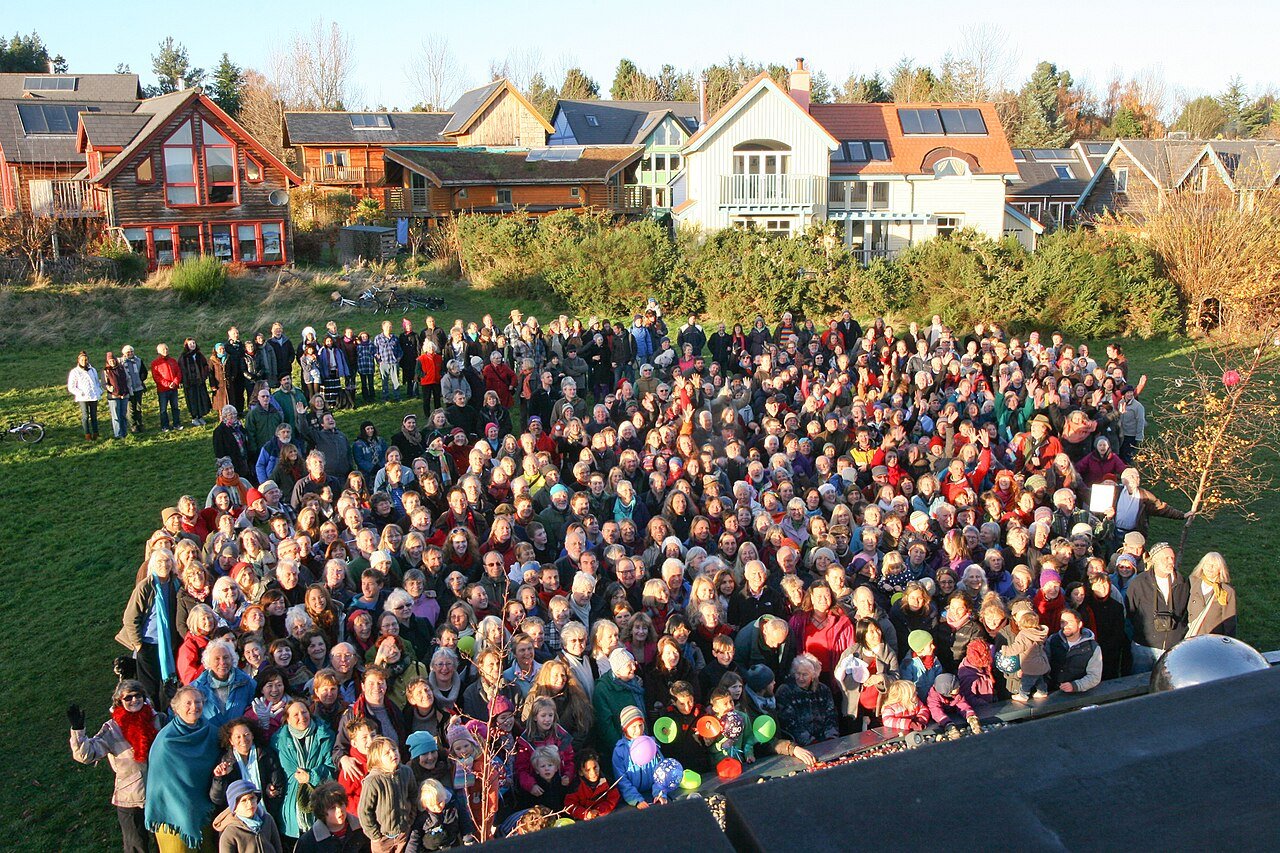
A longstanding community combining ecological design and spiritual practice. On Scotland’s Moray coast, the Park Ecovillage brings together homes, organisations, businesses and learning spaces. Its history includes experimentation with ecological building, renewable energy and water treatment. Spiritual practice and cooperation with nature are also central to its own account of community life. Several organisations contribute to the wider Findhorn community, each with a distinct role in the place’s continuing development.
Spain
Lakabe · Navarre, Spain
A rural intentional community with a shared economy. Lakabe grew from the reoccupation of an abandoned village in 1980. Its residents share work, resources and an economy, making decisions through assemblies. Organic bread production, gardens, woodland care and renewable electricity connect the community’s practical needs with its wider interest in cooperation and alternative rural living.
Los Portales · Andalusia, Spain
A rural community combining agriculture and personal exploration. North of Seville, Los Portales connects food production, solar energy and community organisation with a longstanding interest in psychology and relationships. Its published account describes sociocratic organisation and a culture influenced by dreamwork and shared reflection. Gardens, orchards and other productive activities form part of daily life. The project illustrates how practical ecological aims can become closely connected with a particular approach to personal development.
Matavenero and Poibueno · León, Spain
Linked mountain settlements with independent household economies. These neighbouring settlements in El Bierzo form one ecovillage project, rebuilt from the 1980s onward. Residents manage shared land, spaces and resources through assemblies while maintaining their own household economies and living arrangements. Ecological concerns and care for others sit alongside an explicit commitment to individual freedom.
Sweden
Ängsbacka · Molkom, Sweden
A centre for personal and spiritual exploration with a wider local community. Ängsbacka is known for courses and festivals, while an extended community has established homes in and around Molkom. The centre provides a shared meeting place for people whose everyday lives connect through social activities, creative expression and interests in personal development.
Suderbyn · Gotland, Sweden
A permaculture ecovillage exploring shared ecological living. Near Visby, Suderbyn combines communal life with food growing, ecological building and experiments in renewable energy. Cultural diversity, voluntary simplicity and shared resources are central to the community’s identity. Its residents describe the project as an ongoing effort to develop more sustainable social and practical arrangements.
Understenshöjden · Stockholm, Sweden
An urban ecovillage organised as a housing cooperative. Understenshöjden grew from residents’ efforts to combine environmentally conscious housing with a stronger social setting in Björkhagen. Individual homes sit alongside shared facilities, while residents participate through working groups. It demonstrates how ecological community living can develop within a city and retain separate households.
Wales (United Kingdom)
Lammas (Tir y Gafel) · Pembrokeshire, Wales
A rural ecovillage of ecological smallholdings. Near Glandwr, residents combine homes, food production and livelihoods with a permaculture approach to the land. Water, access routes and electricity involve collective management. Natural or reclaimed building materials and renewable energy form part of a model intended to reduce the environmental demands of rural living.
Ecovillages and intentional communities in North America
These North American examples range from communities with shared incomes to ecological neighbourhoods where households retain private homes and separate finances.
Earthaven · North Carolina, United States
A rural ecovillage organised around ecological learning. In the wooded hills near Asheville, Earthaven brings together residential neighbourhoods, farms, gardens and small businesses. Permaculture has influenced the settlement’s layout, while natural building and ecological infrastructure are part of its practical experimentation. Residents explore different ways of living and working within a shared place. Earthaven presents sustainability as an ongoing community project, with education closely connected to everyday experience.

Photo: Tattycorum /
Wikimedia Commons,
CC BY-SA 4.0.
Dancing Rabbit · Missouri, United States
An ecovillage with explicit ecological agreements. Near Rutledge, Dancing Rabbit puts shared commitments about resource use into the organisation of everyday life. Natural building, renewable energy, cooperatively owned vehicles and habitat restoration are among its documented practices. Different households and smaller living groups coexist within the wider village. Its distinctive feature is the attempt to turn ecological principles into common rules and workable habits that residents can keep refining.
Twin Oaks · Virginia, United States
An egalitarian community with shared income and cooperative work. Founded in 1967, Twin Oaks organises much of daily life through collectively provided resources and a community labour system. Cooking, maintenance and income-producing activities all contribute to the group’s functioning. Its stated values include cooperation, nonviolence and economic sharing, without requiring a common religion. Twin Oaks offers a particularly useful example of how an intentional community can rethink the relationship between work, money and domestic life.
EcoVillage at Ithaca · New York, United States
Ecological cohousing with private homes and shared neighbourhood spaces. Ithaca’s ecovillage comprises the Frog, Song and Tree neighbourhoods, where individual households share common houses, gardens, paths and community responsibilities. Cars are kept around the edges of residential areas, and the wider site includes working farms and open land. Its layout encourages everyday contact between neighbours while preserving household privacy. It shows how community life can be built into the physical design of housing.
The Farm · Tennessee, United States
A historic intentional community that has changed over time. Established in 1971, The Farm grew from the American counterculture around commitments to nonviolence and respect for the Earth. Its history connects communal living with vegetarian food, creative work, environmental projects and service to others. The community’s economic and organisational arrangements have evolved since its early years. That continuing adaptation makes it a useful example of how a shared ideal can take different forms across generations.
Ecovillages and intentional communities in Latin America
From Mexico to South America, these communities connect ecological practices with artistic traditions, education and different approaches to collective organisation.
AldeaFeliz · Cundinamarca, Colombia
An ecoaldea with a strong focus on community governance. Near San Francisco, AldeaFeliz combines ecological building and agroecology with deliberate work on how people organise themselves. Sociocracy, with responsibilities distributed through connected circles and decisions based on consent, is part of its published approach. Education and communication receive attention alongside the physical settlement. The project demonstrates how the social arrangements of an ecovillage can be as central to its identity as gardens and buildings.
Huehuecoyotl · Morelos, Mexico
An intentional community with artistic and travelling roots. Huehuecoyotl began building its village in 1982 in the mountains near Tepoztlán. Its origins include a travelling theatre collective and a wider circle of artists and activists. Music, performance, writing, crafts and ecological experimentation have shaped the community’s story. That creative background gives it a distinctive place in this selection: a shared cultural life helped provide the foundations for a lasting settlement.
El Manzano · Biobío, Chile
A rural community and centre for ecological learning. Located near Cabrero, El Manzano describes itself as a family and rural community working on ecological and social regeneration. Its activities connect agroforestry, organic food, a children’s eco-school and practical learning about permaculture and ecological building. Life on the land and the sharing of skills support one another. The project places community within a wider network of educational and local initiatives.
Ecovila Piracanga · Bahia, Brazil
A coastal settlement with shared ecological commitments. On the Maraú Peninsula, Piracanga occupies a landscape of Atlantic Forest, river, mangrove and beach. Its residents’ website identifies nature, sustainability and self-knowledge as central themes. Solar energy, composting and agreements intended to protect groundwater are among the practices it describes. Homes and different activities coexist within the wider settlement, whose identity is closely connected to the care of its coastal surroundings.

Photo: Natalia Barioni (Nbarioni),
Piracanga 02,
via Wikimedia Commons,
CC BY-SA 3.0.
Ecovillages and intentional communities in Asia
The scale varies greatly here, from an international township to agricultural communities and a small farm built around sharing practical knowledge.
Auroville · Tamil Nadu, India
An international experimental township. Inaugurated in 1968 near Puducherry, Auroville developed around the aspiration of human unity. It encompasses many settlements and activities, including environmental restoration, farming, education, architecture and small enterprises. Spiritual ideals and a complex institutional structure are part of its identity. Its urban ambition and diversity of projects make it an example of community experimentation on a much larger scale than most rural ecovillages.

Photo: Martin E. Pommerening /
Wikimedia Commons,
CC BY-SA 3.0 Germany.
Konohana Family · Shizuoka, Japan
An agricultural community that describes itself as an extended family. At the foot of Mount Fuji, in Fujinomiya, Konohana Family brings together people who share daily life without being related by birth. Farming and mutual support are closely connected to a shared spiritual understanding of people’s relationship with the natural world. Its identity rests on this combination of practical cooperation and a collective philosophy, with a strong emphasis on belonging to the group.
Pun Pun Organic Farm · Chiang Mai, Thailand
A farm community, seed-saving centre and place of learning. Pun Pun combines organic and regenerative farming with an effort to conserve and share seeds. Established in 2003, it has developed around soil restoration, food growing, natural building and practical skills for greater self-reliance. Learning is rooted in work on the land and exchanges with farmers and other participants. Its smaller scale offers a different perspective on the relationship between community and ecological education.
Ecovillages and intentional communities in Oceania
These Australian examples show how community planning can connect private homes, common land, ecological infrastructure and shared decisions.
Crystal Waters · Queensland, Australia
A pioneering village designed through permaculture. Established in 1987, Crystal Waters combines privately owned residential plots with extensive common land and cooperatively managed facilities. The arrangement of homes, productive areas and wildlife habitat reflects its permaculture approach. Residents bring different beliefs and ways of life to a place organised around shared responsibilities for land and community. Its history has made it an important example in discussions of ecological settlement design.
Narara Ecovillage · New South Wales, Australia
An intergenerational residential community with shared ecological infrastructure. On the Central Coast, Narara combines individual homes with common facilities, food-growing areas and land set aside for conservation. Sociocracy guides its organisation, using connected circles and consent to develop decisions. The community explicitly values both neighbourly connection and personal privacy. Narara offers a contemporary example of how housing, infrastructure and governance can be planned as parts of the same community project.
Related community and regeneration initiatives in Africa
These two initiatives extend the picture to projects where community life supports a wider agricultural, educational or ecological mission. Their inclusion offers a starting point for further exploration of the region.
SEKEM · Near Cairo, Egypt
A community-oriented sustainable development initiative. Founded in 1977, SEKEM connects biodynamic agriculture and business with schools, cultural activities and community services. Its work reaches beyond a residential settlement to include farmers, employees and surrounding communities. The relationship between economic activity, education and care for the land is central to its approach. SEKEM shows how community principles can shape a wider network of institutions and productive activities.
Sadhana Forest Kenya · Samburu County, Kenya
A communal project supporting ecological restoration and food security. Sadhana Forest Kenya works with Samburu communities on indigenous food forests, water conservation and greater resilience in food production. People living on site share routines and responsibilities in support of that work. The residential dimension is organised around an environmental mission and includes temporary participants. It illustrates a form of community in which shared daily life serves a specific ecological purpose.
What makes these communities different?
A community’s character becomes clearer when you look at the ordinary arrangements behind its name. The following questions help explain why two places described as ecovillages can offer very different ways of living.
- What is shared? Land, income, meals, tools, domestic work and common spaces can each have different arrangements.
- How are decisions made? Consensus, sociocracy, elected bodies and informal cooperation distribute responsibility in different ways.
- How much autonomy do households have? Some projects organise much of daily life collectively; others leave most routines to individuals and families.
- Which values shape everyday life? Ecological priorities, political commitments, spiritual beliefs and cultural activities can strongly influence expectations within a group.
These details are worth exploring in the communities’ own accounts. They reveal the work involved in sharing a place: maintaining buildings, growing food, earning a living, resolving disagreements and finding room for different needs.
Networks and directories for further exploration
Continue your research
- Global Ecovillage Network (GEN): an international network connecting communities and organisations working on ecological and regenerative living.
- GEN community map: a way to explore further projects by location and follow their published profiles.
- GEN Europe and national networks: resources for exploring European communities and the networks connecting them within different countries.
- Foundation for Intentional Community directory: a broader resource covering different forms of intentional community and shared living.
Sources and further reading
The individual profiles link to the project websites or entries from GEN and RIVE used for this selection. The descriptions draw on these sources for each community’s history, stated aims and organisational approach.
Some network profiles describe earlier stages of a project. Follow the linked sources for subsequent developments, and contact the community directly before making arrangements to visit or explore membership.
For more about finding communities through the international network, read our guide to the Global Ecovillage Network platform and map.