


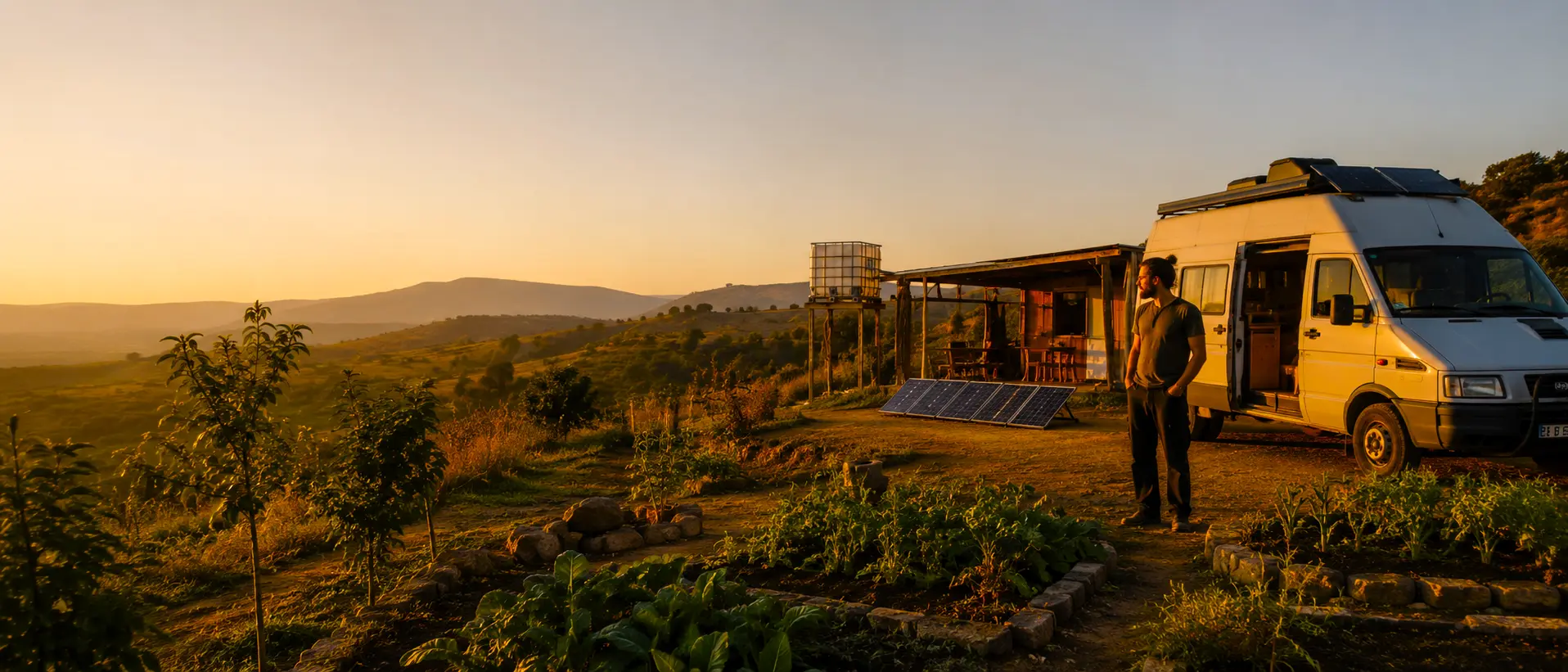
The Wildlanders: an inspiring off-grid family building freedom in Portugal
This reflection was inspired by a video shared by The Wildlanders, a family living off-grid in Portugal and sharing their experience of land, food growing, van life and practical independence.
Off-grid living is often imagined as a romantic escape: a small piece of land, a simple home, trees full of fruit, quiet mornings and a slower rhythm. The reality, as The Wildlanders often show through their work, is more practical and more demanding. It is about reducing dependency step by step, learning useful skills again, and accepting that freedom usually grows slowly.
Who are The Wildlanders? 🔍
The Wildlanders is the project of Dom and Missy, a family living off-grid in central Portugal, near Castelo Branco. After a period of travelling through Europe in a camper van, they fell in love with Portugal and chose to settle on a farm, where they are building a more sustainable, simple and land-based way of life.
Today, they share their daily work online, from gardens, food forests and perennial plants to solar systems, van life, water collection and small steps toward greater self-reliance. Their story shows more than the poetic side of rural living: it also shows the patience, mistakes, practical skills and consistency needed to reduce dependency and build a more concrete kind of freedom.
The message in their video is simple but powerful:
many people do not feel trapped because they are lazy or lack ambition. They feel trapped because modern life often keeps them dependent on rent, bills, debt, supermarkets, fuel, external services and jobs that leave little time to build anything different.
Watch the video here 👇

Off-grid living starts before buying land
One of the most interesting ideas in the video is that the off-grid journey does not necessarily begin with buying land. It can begin much earlier, with a decision to reduce costs, simplify daily needs and create more room to move.
For some people, that first step might be a van.
A van is not a perfect solution and it is not always easy, but it can become a bridge between a conventional life and a more self-reliant one. It can reduce rent, allow people to travel slowly, test different areas, understand climate and landscape, and learn what they actually need before committing to a piece of land.
This is important because many people wait for the “perfect” moment: enough money, enough confidence, enough knowledge, enough certainty. The Wildlanders’ approach suggests something more grounded:
- Start with what you can change now.
- Lower your fixed expenses.
- Learn one useful skill.
- Build something small.
- Repair something.
- Grow something.
- Spend time outside.
- Understand your own limits.
A van can become a transition, not the final dream
In the video, the van is more of a practical tool rather than a lifestyle image.
It is a way to get out of the permanent cycle of paying for a place while still feeling stuck. Once you are living with fewer possessions and fewer fixed costs, it can become easier to save, search for land, and make decisions with more clarity.
Van life also teaches lessons that are useful later on land. You learn how much water you use. You learn how the weather affects your day and how to live with less storage, less electricity, less comfort and more attention. These are not abstract ideas but everyday skills that can make off-grid living less shocking when the time comes.
Of course, this path is not for everyone. Living in a van can be tiring, uncomfortable and legally complicated depending on the country. But as a temporary phase, it can give some people the freedom to step out of expensive routines and start building a more independent future.
Land is only the beginning…
Buying a piece of land does not magically solve everything. In many ways, it opens a new chapter of work. There may be no house, no water system, no reliable access, no food production, no shade, no soil fertility, no workshop and no clear plan. The Wildlanders’ message is not about instant self-sufficiency. It is about slowly building up systems: a place to sleep, a way to collect or manage water, a small garden, trees, perennials, compost, tools, shelter, and knowledge.
Each small improvement reduces dependency a little.
That is also what makes this kind of life different from a holiday fantasy. A food forest takes years. Soil improves slowly. Trees need seasons. Mistakes are part of the process. Some ideas fail. Some crops do not grow. Some systems need to be rebuilt. The dream becomes real only when it is joined with patience, repetition and practical learning.
Freedom is built through skills
A return to basic skills.
Growing food, cooking from scratch, saving seeds, repairing, building, observing weather, understanding plants and managing simple systems were once normal parts of life. Today, many of these skills have been outsourced, forgotten or turned into hobbies. Off-grid living brings them back to the centre. Not because everyone must leave society, but because knowing how to do things gives people more choices.
A person who can grow even a little food, fix simple problems, cook with basic ingredients and live with fewer needs is less dependent on systems they cannot control.
This does not mean total independence, as almost nobody is completely independent. Even off-grid families still need tools, community, money, roads, information, healthcare and support. A more honest goal is lower dependency, more resilience and a closer relationship with the things that keep us alive.
A slower path toward independence
The Wildlanders’ story speaks to many people because it does not present freedom as a product to buy. It presents freedom as something built gradually. First, by questioning the life you have been told to accept. Then, by reducing unnecessary costs. Then by learning how to live with less. Then by creating small systems that support you.
For some, that could mean a van. For others, a rented rural house, a shared garden, a community project, seasonal volunteering, or simply a balcony full of edible plants. The direction matters more than the image.
Living off-grid is not an escape from work. It is a move toward a different kind of work: more physical, more seasonal, more connected to land and daily needs. It can be beautiful, but it asks for effort, patience and humility.
The useful lesson from The Wildlanders is that you do not need to have the whole plan solved before beginning. You can start by becoming less dependent today than you were yesterday. One repair, one saved seed, one reduced bill, one practical skill, one honest decision at a time.
Follow The Wildlanders
You can find The Wildlanders on Facebook and Instagram, where they share their off-grid life, land-based projects, food growing and slow movement toward practical independence.
- Facebook: https://www.facebook.com/TheWildlanders
- Instagram: https://www.instagram.com/thewildlanders
- Video inspiration: https://www.facebook.com/reel/2181965212643014